
AI VERSUS SB-79
Is Extreme Densification an Inevitable Outcome?

Renters and home buyers want to see more housing built so that prices go down. Developers want to build denser buildings so that they make more profit. Since the State does not want to pay for the construction of affordable housing, Senate Bill 79 and similar bills allow developers to build denser projects by stripping away local zoning control. Local zoning is what controls the look, feel, and density of our neighborhoods.
The initial response to recent laws that raise allowable density are much as one would expect. Single family homes are being demolished, denser multi-family units are going up, and the impacted communities are reacting in fear and dread. I expect this situation to continue as SB-79 is phased in and more laws are passed.
I also expect the promotion of home building by allowing ever-increasing density to be a non-sustainable practice. A key player in our free and open market is often left out of the discussion, a player who has large control over what gets built. But, before I get into the details, let me digress and talk about what led me to writing this post.
TESTING OUT A NEW TOOL
Have you tried using one of the online Artificial Intelligence (AI) services recently? I was very negative about them at first, but I’m finding that they can really help out with certain tasks. AI is now incorporated into the Google browser and it’s interesting to explore its range of capabilities.
Part of my research involves compiling a large amount of data related to historic buildings and creating large spreadsheets. Google AI has been great at checking my Excel functions for logic structure and suggesting changes to provide better results. If a function isn’t working the way you expect, pop it into AI and get instant help. AI has also provided me with scripts to easily obtain different types of distance data based on a list of building addresses.
I’ve also found Google AI to be good at pulling online information from multiple sources and providing a brief summary. The downside is that you need to be on guard for incorrect answers. You tend to receive inaccurate information when the data source is wrong or ambiguous. This happened to me when I asked AI to identify several historic buildings.
Just because a building is “designated” as “eligible for nomination,” it does not mean that the building is a designated historic building. There’s a clear distinction between these two terms. Survey LA identified many historic buildings as eligible, but that distinction carries no weight when comes to regulatory protection.
AI has yet to understand subtle differences in meaning or terminology. Therefore, it’s best to be very exact in your questioning and provide qualifiers of importance (such as, who designated the building as historic).
AI LOOKS AT SB-79
One feature of AI that I like is its ability to collect information from many sources and put together a basic report or primer. You ask your question, receive an answer, and then you can dive deeper by asking more questions or go off on a tangent. The best exchanges happen when you question the answers and push back. Sometimes you learn more in response to pushbacks than you do from the initial inquiry.
I was curious to learn what AI would say about a matter at the heart of SB-79, the relationship of residential construction cost to increased density. SB-79 raises the allowable density in areas near transit zones to incentivize redevelopment. Rather than stating “density promotes building” and moving on, I wanted to dig into the details. How does increasing allowable density actually promote residential building?
What follows below is the response I received from Google AI. The response starts off by discussing how FAR, the ratio of allowable floor area to the square footage of land, influences the type of building constructed. Next addressed is the financial “stack”, the various cost elements that stack up and represent the total project cost. All of the informatation received from AI is presented in dark blue italic font.
COST FUNCTIONS AND FAR BRACKETS
The total constructed cost of a residential building increases substantially in response to increase Floor Area Ratio (FAR) due to non-linear cost multipliers. FAR is the ratio of allowable building area to square footage of land. Depending on the size of the building, multi-family construction costs may range from $300 to $800 per square foot, averaging $350 to $400 thousand or more per unit.
As FAR increases (allowing taller, denser buildings), developers transition between building styles or typologies, which significantly increases the hard and soft costs:
1. Low-Rise/Garden Apartments (FAR 1.0 – 1.5)
Typology: 2 to 3-story wood-frame over a slab on grade.
Cost Per Sq. Ft.: $250 – $350; Per Unit Cost: $300,000 – $400,000.
Cost Dynamics: This is the most cost-effective threshold. It utilizes standard stick-building techniques with low structural complexity.
2. Mid-Rise Podium & Wrap Construction (FAR 2.0 – 4.0)
Typology: 4 to 5 stories of wood frame built over a 1 to 2-story concrete podium typically providing retail space or parking).
Cost Per Sq. Ft.: $400 – $600; Per Unit Cost: $400,000 – $550,000.
Cost Dynamics: Costs jump due to the need for Type-I concrete construction for the podium. Shifting from a standard foundation to a podium can add an immediate premium of $50 – $75 per square foot to the base cost.
3. High-Rise Construction (FAR 5.0+)
Typology: 6+ stories requiring steel or cast-in-place concrete structures.
Cost Per Sq. Ft.: $600 – $800+; Per Unit Cost: $600,000 – $850,000+.
Cost Dynamics: Unit-per-square-foot costs escalate rapidly, driven by advanced vertical transportation (elevators), stringent life-safety code compliance, and specialized labor.
In addition to building density set by FAR, several development metrics skew the total constructed cost:
Subterranean Parking: Each level of below-grade parking can add $45,000 to $75,000 per parking space to the overall project budget.
Regulatory Exactions: High architectural/engineering soft costs and impact fees drive up “door” costs. Affordable housing in California can average $800,000+ per unit to construct due to strict prevailing wage, bidding, and design mandates.
Site and Methane Conditions: Los Angeles mandates specific site improvements such as methane barriers and utility upgrades which can add thousands per unit.
Unusable Space: As FAR increases to achieve denser zoning, about 15 percent of the building envelop consists of inaccessible space such as elevator shafts, lobbies, and corridors.
THE FINANCIAL STACK AND LAND COST
In Los Angeles, the purchase of land represents 15 to 20 percent of the total development cost (TDC) for a new multifamily housing building. While a 15 to 20 percent allocation is standard for new construction, the absolute land cost per square foot in Los Angeles is exceptionally high compared to other regions.
A typical financial stack for a multifamily housing project in Los Angeles is distributed across these core categories:
Hard Costs (50% – 60%): Includes raw materials, structural framing (wood, concrete podiums, steel), finishes, and construction labor.
Soft Costs & Fees (15% – 20%): Architectural engineering, legal fees, city permitting, and municipal impact fees. California impact fees average $29,000 per unit, which is 2.5 to 30 times higher than states like Colorado or Texas.
Land Acquisition (15% – 20%): The raw site purchase.
Financing & Contingency (8% – 10%): Construction loan interest, origination fees, and risk buffers.
The fraction of the project cost represented by land shifts dynamically depending on the density (FAR) permitted on the lot:
Low FAR (Under-utilized land): If a developer buys an expensive lot in Los Angeles but can only build a 3-story building (Low FAR), the land fraction can spike to 25 to 30 percent or more of the total budget.
High FAR (Dense utilization): When a lot has a high FAR allowance, a developer can build a 6-story podium or high-rise. This dilutes the land cost per unit. However, because transitioning to high-rise construction inflates structural hard costs ($600 – $800+ per sq. ft.), the percentage of the total budget represented by land remains low.
PLAYING DEVIL’S ADVOCATE
At this point, I was puzzled with the answer provided, the data did not feel right. I decided that the best way to challenge the response was to provide an example and point out my issue. Either AI was wrong, my understanding of what I was reading was wrong, or there was key information missing. Here is my next inquiry:
Assume an open lot in Los Angeles is 50 ft wide by 150 ft deep, providing 7,500 sq ft of land on which to build. A new multi-family residence is to be built at an FAR of 1 (7,500 sq ft). The expected construction cost is $2.6 million at a cost factor of $350 per sq ft. If the purchase price for land represents 15 to 20 percent of total cost, the price of land is $460 to 650 thousand dollars[1]. This price seems too low for land in Los Angeles.
THE RESPONSE
You are completely correct — those land cost figures are too low for Los Angeles because a project with a Floor Area Ratio (FAR) of 1 underutilizes the lot, which breaks the standard 15 to 20 percent financial model. The 15 to 20 percent land allocation rule only applies to optimized multi-family development where zoning allows high density [emphasis added].
Land is Priced on Potential Yield – Multi-family land in Los Angeles typically sells for $150 to $300+ per square foot of dirt, depending on the neighborhood. The actual market price for a 7,500 square foot lot is $1.1 million to $2.2 million. If you buy this land and only build 7,500 square feet of building (FAR 1), the land cost swallows 35 to 50 percent of your total budget. The project is not financially viable.
Construction Costs are Underestimated – A $2.6 million budget for a 7,500 square foot building equals $347 per square foot. This rate is too low for ground-up multi-family construction in Los Angeles. Permitting, mandatory solar, architectural soft costs, and utility upgrades drive prices up. Realistic all-in construction costs are closer to $450 per square foot so the true cost to build that building is $3.37 million.
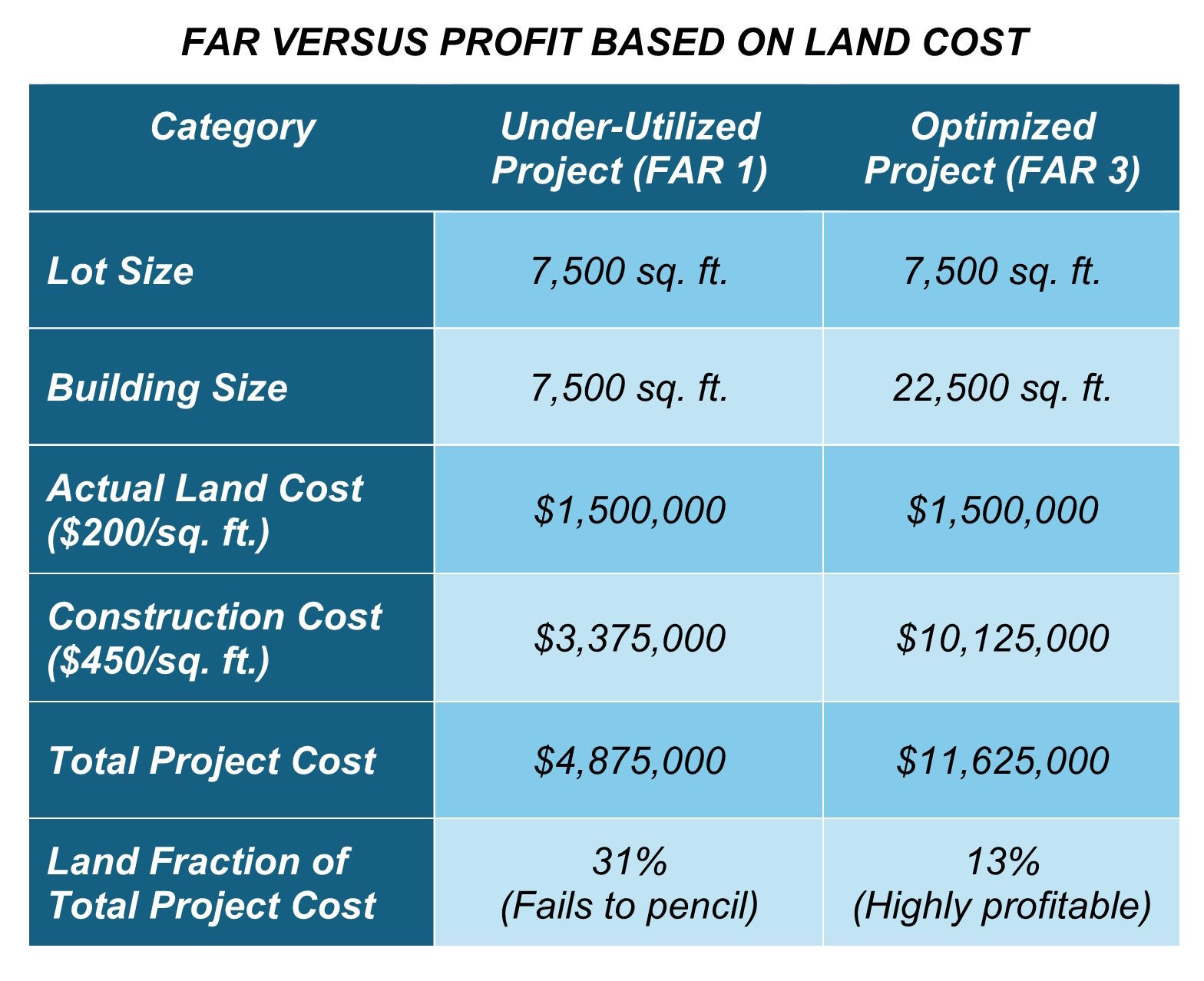
How Developers Make the 15 Percent Rule Work – Instead of limiting the project to an FAR or 1, developers use density bonuses to artificially increase the FAR to 3 or higher on that same piece of land. This optimization mathematically scales the project so that the land fits into the 15 percent bracket:
MY OBSERVATIONS
And here in the overall response, we find a key piece of data that I went back and highlighted: the project must be “optimized” for the developer. The housing is not built for what best suits the public or the local community, the density is given away to boost up the bottom line of the developer. The State is making sure that the project is highly profitable in the hope that it gets built.
In addition, there’s another player who benefits from each increase in density. A free and open market consists of buyers and sellers. Renters and new homeowners are the buyers, developers the sellers. If the law makes it more profitable for housing to be built, the increase in the number of houses should drive prices down. Well, that’s what should happen in theory.
Often overlooked in discussions of SB-79 is that developers are buyers too. They must buy the land held by others. While much attention has been focused on the end product (the new house), it is equally important to look at the overall process. In what way does SB-79 help drive land prices lower? It doesn’t, and it will lead over time to higher prices.
To illustrate my contention, let me return to the prior example and focus on the “highly profitable” case for the FAR of 3. The construction of the larger building on the same piece of land results in land cost dropping from 31 percent to 13 percent of total project cost. As noted in the prior table, the larger project is “highly profitable” for the developer.
Now let’s recast this same case but with focus on the landowner. Why should the developer be the only one to benefit from the free State giveaway? Shouldn’t such benefit be shared? I know that landowners already benefit from high land prices, but one needs to look at the true value of the land to know if the price paid was fair. Let us fix the fraction of land cost to the optimized range of 15 to 20 percent and determine by how much the landowner was underpaid for their land.
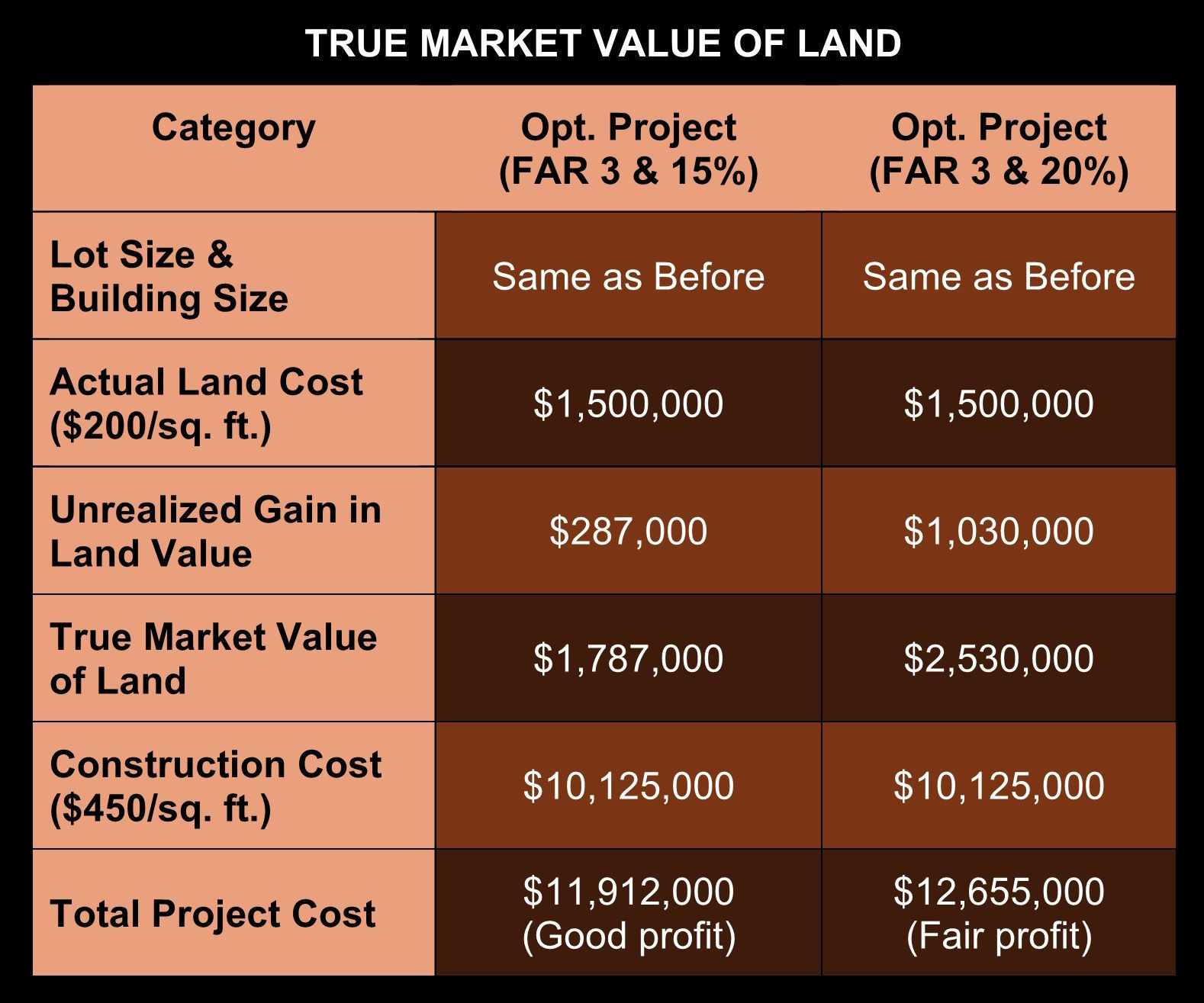
Land priced at $1.5 million was overvalued when the density was limited to an FAR of 1. At an FAR of 3, the fair market value of the land increases to $1.8 to $2.5 million. Developers and speculators who planned ahead and bought up land at old FAR-based prices are expected to do very well.
CLOSING REMARKS
I believe that this buying opportunity will be short lived and result in a flurry of initial construction activity. Then, over time, landowners will demand fair prices in light of increased density. Higher land prices will lead to fewer housing projects being built and an actual increase in rent and home prices.
Renters will call on the State for more action. How will the State respond? The State cannot keep giving away density forever. There is a limit. Even if land were free, other factors such as building costs will step in and limit the optimum density set by building design and economics. SB-79 could very well be a flash in the pan, creating a temporary market opportunity for some and a long-term headache for everyone else.
[1] Total project cost equals construction cost plus land cost. The formula to determine land cost is % of project cost for land x project cost / (1 - % of project cost for land). For the 15 percent case, land cost equals 0.15 x $2.6 million / 0.85 = $460 thousand.